
Kay Takeaway
By reading this article, you will learn:
- What over-insulating really means and why “more is not always better.”
- The risks of adding too much insulation such as moisture, mold, poor air quality, wasted money, and even summer overheating.
- How to know if your home or attic already has enough insulation by checking building codes, R-values, and doing an energy audit.
- The idea of diminishing returns — after a certain point, extra insulation saves very little.
- The best practices to follow so your home stays comfortable and safe: never block vents, use vapor barriers when needed, choose the right material for your climate, and work with professionals.
- Why the balance between insulation and ventilation is the golden rule for a healthy, efficient home.
Can You Over-Insulate a House?
Many homeowners believe that “the more insulation, the better.” But is this always true? Can a house be over insulated? Can you put too much insulation in the attic? The short answer is, yes, you can over-insulate your home. While your home should be well-insulated against the cold and keep you cool during hot summer months, that doesn’t mean you should cram the walls full. Read on to discover why over-insulating a home isn’t a good idea.
WHAT HAPPENS IN AN OVER-INSULATED HOME
An over-insulated house is susceptible to mold since it is so tightly sealed that it prevents moisture from escaping. It also prevents air from entering, circulating, and exiting, which can significantly reduce indoor air quality. DIY efforts may do more harm than good. Rather than removing the insulation yourself, consult with professionals who can determine your insulation requirements and ensure new systems are installed correctly.
What Does Insulation Do?
Insulation slows down the transfer of heat. In winter, it keeps warm air inside. In summer, it blocks the outside heat. The effectiveness of insulation is measured by R-value — the higher the R-value, the more resistant it is to heat flow.
Every climate has different insulation needs. Local building codes usually say how much R-value you need in your area. For example, homes in colder northern zones need much higher attic R-values than those in mild southern climates. Following these guidelines helps balance comfort, safety, and cost.
“Insulation isn’t just about adding more material — it’s about using the right type and amount for your home’s design and climate,” says Michael Turner, a building science consultant with over 20 years of experience. “If you meet or exceed your local code requirements and combine insulation with proper air sealing and ventilation, you’ll get the best comfort and efficiency without the risks of over-insulating.”
THE GOLDEN RULE FOR INSULATION
To understand how much insulation you need, you need to understand how heat flows. Heat migrates from a hot to a colder area. Insulation can slow it down.
This is where the material’s R-value comes into the picture. This value should be at least twice the code minimum as a rule of thumb. The rule isn’t set in stone, but it can give you a general idea.
WHERE YOU SHOULD ADD INSULATION
To prevent over-insulation in new construction, focus on adding the material in these areas:
THE ATTIC
Your attic will retain most of the heat from the lower floors. If it escapes during winter, it will increase your energy bills. Insulation can prevent that from happening.
THE WALLS
Insulation in the walls can reduce the energy required to heat or cool your home, reducing your bill. The material will also dampen sound, giving you and your family more privacy.
THE FLOORS
While heat rises, you can lose a lot of it through the floors, especially flooring over basements or other unheated areas in your home. Whether you have spray, batt, or blow-in insulation, you can prevent that heat from dissipating too fast and reduce noise. If you and your family live on different floors, adding insulation will be worth your while.
CRAWLSPACES
Heat can escape through your home’s hidden nooks and crannies, such as crawlspaces. Insulate these spaces to retain more heat and prevent the pipes and ductwork from freezing when temperatures are below freezing.
THE BASEMENT
Most homeowners overlook this part of their house when insulation is installed, not knowing it has tremendous benefits. A well-insulated basement can be transformed into a living space and increase your home’s market value. The space will still work to retain heat, even if it is unfinished.
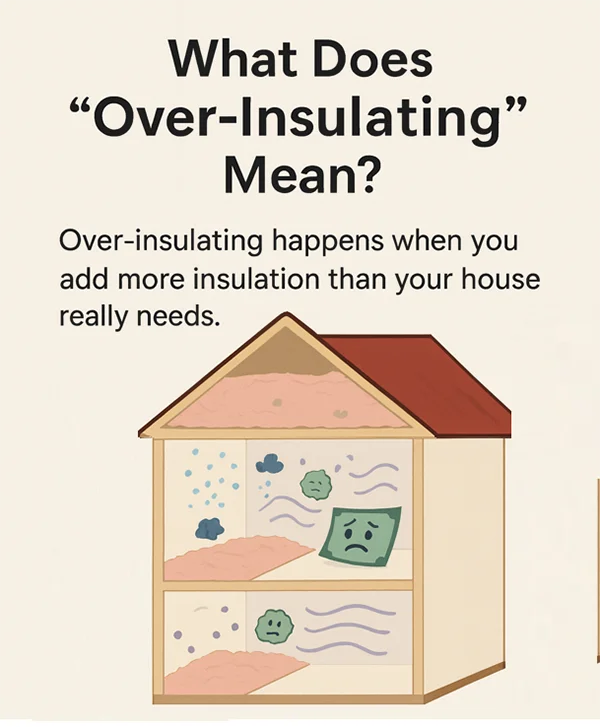
What Does “Over-Insulating” Mean?
Over-insulating happens when you add more insulation than your house really needs. Many people think “the more the better,” but that is not always true. Insulation works best when it is balanced with airflow and moisture control.
If you go too far, instead of saving more energy, over-insulating can create problems such as:
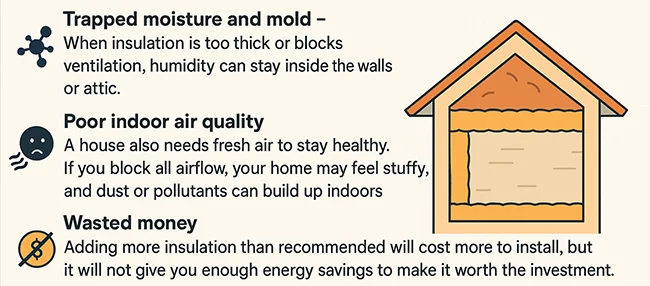
- Trapped moisture and mold – When insulation is too thick or blocks ventilation, humidity can stay inside the walls or attic. Over time, this moisture can lead to mold, rot, or damage to the building materials.
- Poor indoor air quality – A house also needs fresh air to stay healthy. If you block all airflow, your home may feel stuffy, and dust or pollutants can build up indoors.
- Wasted money – Adding more insulation than recommended will cost more to install, but it will not give you enough energy savings to make it worth the investment.
It is also important to know the difference between diminishing returns and real risks.
- Diminishing returns means that after a certain level, each extra inch of insulation saves less and less energy.
- Real risks include trapped moisture, mold, and damage that can cost much more to fix later.
The goal is not to add as much insulation as possible, but to find the right amount for your climate and home design.
Risks of Over-Insulating a House
Putting too much insulation in your home may sound like a good idea, but it can actually create problems. A house needs the right balance of insulation, airflow, and moisture control. If you add more than recommended, you may face the following issues:
1. Moisture Problems. When insulation blocks ventilation, humidity can stay trapped inside the walls, attic, or roof. Over time, this moisture can cause mold, wood rot, or roof damage.
2. Poor Ventilation. Every home needs fresh air to stay healthy. If you add too much insulation and stop airflow, the air inside can feel stuffy, heavy, and unhealthy. Pollutants and dust may also build up indoors.
3. Wasted Money. Once your house already has the correct R-value for your climate, adding more insulation will not save much extra energy. You may spend hundreds or thousands of dollars on extra insulation but only save a small amount on bills.
4. Summer Overheating. In hot weather, too much insulation without good ventilation can make your house overheat. The heat stays trapped inside, and your cooling system needs to work harder.
“More insulation is not always better. The smart choice is to follow building code guidelines and combine insulation with proper airflow and ventilation.” – Beni, Senior Technical at Pure Eco Inc.
Can You Over-Insulate an Attic?
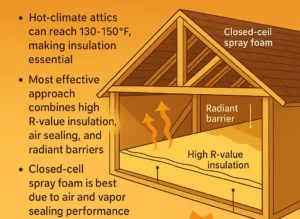
Yes. While most attics do not have enough insulation, adding too much can cause problems. Over-insulating may block vents, trap moisture, create condensation, and even lead to roof damage or ice dams in snowy climates.
The best solution is balance. Insulation in the attic should always work together with proper ventilation. Open soffit vents, ridge vents, or attic fans help control moisture and airflow, keeping your home safe and energy efficient.
How Much Insulation Do You Really Need?
The right amount of insulation depends on where you live. In cold climates, homes need higher R-values, especially in the attic, to stop heat from escaping. In mild climates, a moderate R-value is usually enough to keep the house comfortable. In hot and humid climates, the key is balance. You need insulation to block heat, but you also need good ventilation to avoid trapped moisture and overheating.
To know if your home already has enough insulation, you can start by checking local building codes. These codes give clear recommendations for the R-value in your area. You can also measure the thickness of the insulation in your attic to compare it with the recommended level. For a more complete picture, consider an energy audit. Tests like a blower door test or an infrared scan can show where heat escapes and where you may need more insulation.
Recommended Insulation by Climate
| Climate Type | Attic R-Value (Typical) | Notes for Homeowners |
| Cold climates | R-49 to R-60 | Add more insulation in the attic to keep heat inside during long winters. |
| Mild climates | R-30 to R-38 | A moderate level is usually enough for comfort and energy savings. |
| Hot, humid climates | R-30 to R-49 | Combine insulation with good ventilation to avoid trapped heat and moisture. |
Cost vs Savings: The Point of Diminishing Returns
Adding insulation is a good investment, especially if your home does not have enough. The first layers of insulation make the biggest difference because they stop a large amount of heat loss. This means your heating or cooling system works less, and your energy bills go down.
But after your house already has enough insulation, adding more will not bring the same benefits. Each new layer saves less money than the one before. This is called the point of diminishing returns.
For example, moving from R-10 to R-20 can save you a lot. But if you go from R-30 to R-40, the extra savings may only be a few dollars each year. In this case, the money you spend on the extra insulation will not pay itself back through energy savings.
The smart choice is to reach the recommended R-value for your climate and stop there. More than that usually costs more than it saves.
Best Practices to Avoid Over-Insulating
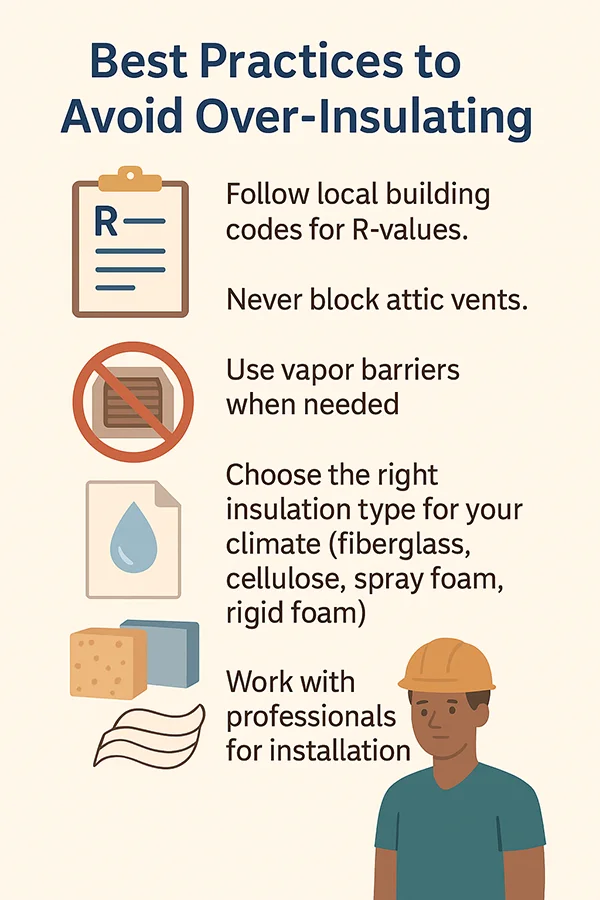
The best way to avoid over-insulating is to follow a few simple rules. First, always check your local building codes. These give you the correct R-value for your climate, so you know how much insulation you really need.
When adding insulation to the attic, make sure you do not block the vents. Good airflow is important to prevent moisture and keep the roof safe. In some cases, you may also need a vapor barrier to stop humidity from moving into the walls or attic.
It is also important to choose the right insulation material. Fiberglass, cellulose, spray foam, and rigid foam all work differently, and the best choice depends on your home and your local weather.
Finally, working with a professional installer can save you problems later. An expert can check your home, suggest the right materials, and make sure the insulation is installed correctly. This way, you get comfort and savings without the risks of over-insulating.
Myths About Over-Insulation
Many homeowners believe that adding more insulation will always make their home better, but this is not true. Let’s look at some common myths:
Myth 1: “More insulation always saves more money.”
This is not correct. After your home reaches the recommended R-value, each new layer of insulation saves less and less. At some point, the cost of extra insulation is higher than the savings on your energy bills.
Myth 2: “Extra insulation solves all comfort problems.”
Comfort in the home is not only about insulation. Air leaks, drafts, and poor ventilation can still make rooms uncomfortable, even with thick insulation. Sealing gaps and keeping good airflow are just as important.
Myth 3: “A house can never be too tight.”
In reality, a house that is too sealed without ventilation can create problems. Without enough fresh air, the air inside may feel stuffy, and humidity, dust, or pollutants can build up. A healthy home needs both insulation and proper ventilation.
FINAL WORDS
Pure Eco Inc. is a five-star rated, licensed, and insured company that serves homeowners in and around the Los Angeles area. Each insulation job is overseen by a project and field manager who can answer all your queries. We also provide all photos and necessary documents required for rebates. Contact us for a free home estimate and quote today by dialing (877)870-7998.
FAQs
Can a house be over insulated?
Yes, if you add more insulation than needed, it can trap moisture and reduce ventilation.
Can you over insulate an attic?
Yes. Too much attic insulation can block airflow, cause condensation, or create ice dams.
Will extra insulation always lower my bills?
No. After a certain R-value, extra insulation brings very little extra savings.
What’s better: more insulation or better ventilation?
Both are important. Insulation keeps heat in/out, and ventilation keeps air and moisture balanced.