
At Pure Eco Inc., we often guide homeowners through the decision between blown-in vs batt insulation for their property. And the truth is that the choice goes beyond materials, as climate, structure, and long-term efficiency all matter equally.
In Los Angeles and across Southern California, where hot summers, mild winters, and Title 24 Energy Efficiency Standards define building performance, choosing the right insulation has to do with comfort, as well as compliance, savings, and sustainability.
Drawing on scientific data and Pure Eco Inc.’s field expertise, this guide will help you make an informed decision as you will be able to determine which insulation delivers the greatest comfort, efficiency, and value for your home.

Key Takeaways
- Blown-in insulation will adapt to irregular cavities, making it ideal for retrofits and attics.
- Batt insulation can be cost-efficient in new builds with standard framing.
- Proper installation quality and air sealing often matter more than the material type.
- California’s climate favors dense, airtight insulation to reduce HVAC load year-round.
Comparison Table: Blown-In vs Batt Insulation
Feature | Blown-In Insulation | Batt Insulation |
Composition | Loose-fill fiberglass or cellulose | Fiberglass or mineral-wool batts |
Installation | Blown with specialized equipment; fills gaps easily | Pre-cut panels that are fitted manually |
Ideal Use | Retrofits, attics, irregular framing | New construction, open cavities |
Average R-Value | R-2.2 – R-3.8 per inch | R-2.9 – R-3.8 per inch |
Coverage | Excellent gap coverage | Limited by cavity shape |
Moisture Risk | Moderate if improperly sealed | Higher if exposed to humidity |
Cost Range (LA Market) | $1.30 – $2.50 / sq ft installed | $0.90 – $1.80 / sq ft installed |
Maintenance | May require top-up if settling occurs | Minimal. You need to check for compression |
Best for | Older homes & attics in retrofits | Standard interior and exterior walls in new builds |
What Is Blown-In Insulation?
Blown-in insulation, also known as loose-fill insulation, uses small fibers or particles of cellulose, fiberglass, or mineral wool. These are blown into attics, wall cavities, or floors with specialized equipment for even distribution and proper depth. Because the material is loose, it fills gaps, voids, and irregular shapes that pre-cut insulation panels can’t cover.
The U.S. Department of Energy emphasizes that “loose-fill insulation can conform to any space without disturbing structures or finishes.” This flexibility makes it especially effective for retrofits and renovations, where insulation must be added without removing walls or ceilings. At Pure Eco Inc., our team uses advanced blowing equipment to achieve the precise density required by DOE and ENERGY STAR standards, so that full coverage and consistent R-value across the entire insulated area.
What Is Batt Insulation?
Batt insulation, sometimes called blanket insulation, is made from large, pre-cut panels of fiberglass or mineral wool that fit between studs, rafters, and joists. These batts are commonly used in new builds or open framing conditions because they are simple to install and require minimal equipment. As it is available in standard sizes and R-values, batt insulation provides predictable thermal resistance when fitted properly.
However, if installed with gaps, folds, or compression, performance can drop by as much as 20%. Research supported by the DOE’s Materials Fact Sheet also shows that advanced methods such as the Blow-In-Blanket System® (BIBS) achieve significantly better cavity fill than conventional batts. This finding reinforces Pure Eco Inc.’s commitment to professional installation, so delivering batt projects that are fitted and sealed to achieve their full rated R-value.
Blown-In Insulation – Advantages
- Superior at filling odd-shaped cavities and around obstacles (wires, pipes, beams).
- When installed correctly, coverage tends to be more uniform and less likely to leave uninsulated voids.
- Some materials (like cellulose) have high recycled content and good fire resistance profiles.
- In retrofit scenarios, it can be done with minimal disruption without the need to remove drywall in some dense-pack applications.
The U.S. Department of Energy confirms that “loose-fill insulation can conform to any space without disturbing structures or finishes”. This makes it especially effective in older LA homes with uneven framing.
Blown-In Insulation – Disadvantages
- Requires specialized equipment and a trained installer. This leads us to the conclusion that DIY may be harder or less reliable.
- If improperly installed (insufficient density, voids, or settling), performance can degrade.
- Blower noise, dust during installation, and settling may be minor concerns.
- Typically, higher upfront cost compared to batt in simple framing cases.
Batt Insulation – Advantages
- Cost-effective in new construction with standard framing.
- Installation is straightforward in regular stud/joist cavities.
- Materials are widely available, and many local installers are familiar with them.
- Minimal special equipment required.
Batt Insulation – Disadvantages
- It’s possible that pre-cut panels will not fit perfectly in irregular or retrofit framing, leaving gaps or compression that reduce effectiveness.
- Batt insulation is less effective at filling around obstructions or odd shapes compared to blown insulation.
- If it’s compressed or incorrectly fitted, the R-value can drop significantly.
- In retrofit cases, cutting and spacing panels may increase labor and waste.
Choosing the Right Option for Your Home
The decision between blown-in and batt insulation should rest on measurable performance, not assumptions. From installation logistics and R-values to long-term savings and environmental impact, here’s how Pure Eco Inc. helps homeowners evaluate each option.
- In new construction with standard framing, batt may be cost-efficient. In older homes with irregular framing or retrofit needs, blown-in insulation often yields better coverage.
- If your walls or attic joists are accessible and uniform, batt works. But when there are obstacles, electrical lines, or partially finished areas, blown-in performs better.
- While blown-in may cost slightly more upfront, its energy efficiency and reduced air leakage can generate greater savings over time.
- No matter which you choose, ensure your installer follows DOE best practices. These are correct densities for blown-in and a tight, compression-free fit for batts.
Pure Eco Inc. performs both batt insulation installation and blown-in attic insulation services throughout Los Angeles County, including Burbank, Glendale, Pasadena, and Woodland Hills. With us, every project meets or exceeds California Title 24 requirements.
Transform Your Los Angeles Home into a Year-Round Comfort Zone
If you’re curious which insulation solution suits your LA home best, at Pure Eco Inc., we provide attic insulation, insulation removal, and energy-saving retrofit services across Greater Los Angeles. Our certified technicians assess your structure, ensure Title 24 compliance, and deliver eco-friendly products that last for many years to come.
For over a decade, Pure Eco Inc. has been Los Angeles’ trusted partner for smarter, greener homes. From attics to walls, we deliver insulation that performs, cuts costs, reduces energy waste, and restores real comfort to your living space.
Connect with us to schedule your free consultation and experience how expert insulation can make your home feel like home, season after season.
Frequently Asked Questions
What’s the difference between the R-value of blown-in vs batt insulation?
The R-value measures a material’s resistance to heat flow; the higher the R-value, the better the insulation’s performance. High-density fiberglass batts that are designed for 2×6 walls typically deliver an R-value of about R-21, offering consistent results when properly installed. Blown-in insulation, on the other hand, varies depending on the material and depth, ranging from R-2.2 to R-3.8 per inch. When installed at the correct density, blown-in insulation can match or even exceed batt performance, particularly in irregular spaces. In both cases, professional installation and proper air sealing are paramount when it comes to achieving the advertised R-value and maintaining it over time.
Is blown-in insulation more energy-efficient?
In many homes, especially older or unevenly framed ones, blown-in insulation tends to be more energy-efficient as it conforms to every crevice, eliminating the gaps and voids that often allow conditioned air to escape. This continuous coverage stabilizes indoor temperatures and reduces strain on heating and cooling systems, achieving measurable energy savings over time.
Does blown-in insulation settle over time?
Yes, it can, though proper installation significantly minimizes this risk. If blown-in insulation is installed at the correct density and depth, professionals can calculate its “settled thickness” so that even after minor settling, the insulation maintains its intended R-value. Inadequate installation, on the other hand, can cause uneven coverage and reduced performance, which is why density verification and professional equipment calibration are essential.
Can I install batt insulation myself?
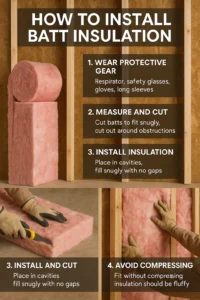
Batt insulation is easier for homeowners to install compared to blown-in, but precision is critical. Each panel must fit snugly between studs without gaps, folds, or compression, as even small imperfections can reduce performance by up to 20 percent. Following the U.S. Department of Energy’s installation guidelines, including using vapor barriers and sealing around wiring, can be very helpful in achieving better results and preventing moisture issues.
Can I combine both types?
Yes. In fact, many homeowners achieve excellent results by combining the two systems. Batt insulation works effectively in accessible wall cavities and floors, while blown-in insulation provides superior coverage in attics, crawl spaces, and enclosed walls. This hybrid approach creates a continuous thermal barrier that maximizes energy efficiency and indoor comfort throughout the entire home.
Sources
- https://www.energy.gov/energysaver/types-insulation#:~:text=Loose%2Dfill%20insulation%20consists%20of,and%20perlite%20are%20typically%20poured.
- https://insulationinstitute.org/im-a-building-or-facility-professional/commercial/comparing-insulation-types/
- https://www.energy.gov/energysaver/insulation-materials#:~:text=One%20variation%20of%20fiberglass%20loose,by%20this%20method%20of%20application.
- https://www.energy.gov/energysaver/types-insulation#:~:text=Loose%2Dfill%20and%20blown%2Din&text=Blown%20into%20place%20using%20special,shaped%20areas%2C%20and%20around%20obstructions.